
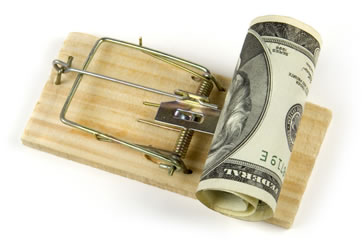
The Price of Money
Money is Expensive
The single most expensive item you will ever have to buy is money.
According to ACCC, American Consumer Credit Counseling, the average person will spend $280,000 to “borrow” money over the course of their lifetime. That means that over a quarter million dollars of your hard earned cash will be used for no other purpose than to acquire loans for cars and houses, and to float credit card balances.
Credit and debt are luxuries designed to finance large purchases people could never afford otherwise. Paying interest on borrowed money may seem like an evil imposition to many. However, the reality is that without a lending and credit system people could never achieve many of the things they take for granted. Imagine how difficult it would be to buy a new car, a house or finance a college education if we had to pay every penny from our own pocket.
The United States Federal Government has recently established laws that protect consumers from “predatory lending”; what might be called legal loan sharking. Limits to the rates lenders can charge have been established. However, those rates are highly dependent upon a “Credit Rating” system used to determine the risk factor of the borrower.
Low credit ratings identify high risk customers who are in turn charged higher interest rates when taking out a loan or acquiring a credit card. The industry considers it nothing more than a risk factor based on past performance. Keep in mind that a Credit Score is not the same as a Credit Report. The Score is based on an individual’s Report as calculated by an industry source known as FICO (Fair Isaac Co.)
A Credit Report carries all the detailed information of a person’s financial history; credit cards, auto and home loans, bankruptcy and more. Late payments or defaults on any account, including utilities or even department store credit cards, are all likely to show up on the Credit Report. That detailed history is then used to compile a FICO Credit Score.
Most institutions will likely review both before offering terms on high end purchases. Primary credit cards and short term financing, like furniture and appliances, usually only consider the Credit Score. In any case, consumers can save a whole lot of money over their lifetime by working to keep their credit score high.
Paying the balance on a credit card religiously will result in no less than $12,000 savings versus carrying a balance on the account. Allowing a credit card to float, or rather not paying the entire bill with every statement, will cost consumers dearly.
In simple terms, by borrowing $200,000, a home loan let’s say, with an APR (Annual Percentage Rate) of 5%, each year there will be an additional $5,000 to $9,000 added to the bill. Interest on that loan accrues on the principal balance each month, which will decline by the prior month amount paid to principal. Over 30 years that could turn into another $200,000 or more.
The best way to reduce the expense of a mortgage or auto loan? Make additional payments to the principal debt each month. By reducing the balance owed the cost of the loan can be drastically reduced over the lifetime of the debt. This tactic can also improve an overall credit score which in turn makes other borrowing less expensive.
All these things can be confusing and overwhelming to say the least. Our best advice? Contact a trained financial professional who can help you sort out these details.
The professionals at Christofi and Company have helped clients save hundreds of thousands of dollars in unnecessary interest payments. Give us a call today to discuss ways to reduce some of those lifetime expenses and leverage your money for a better future.